
Tubeformer TF 1401 Ultra
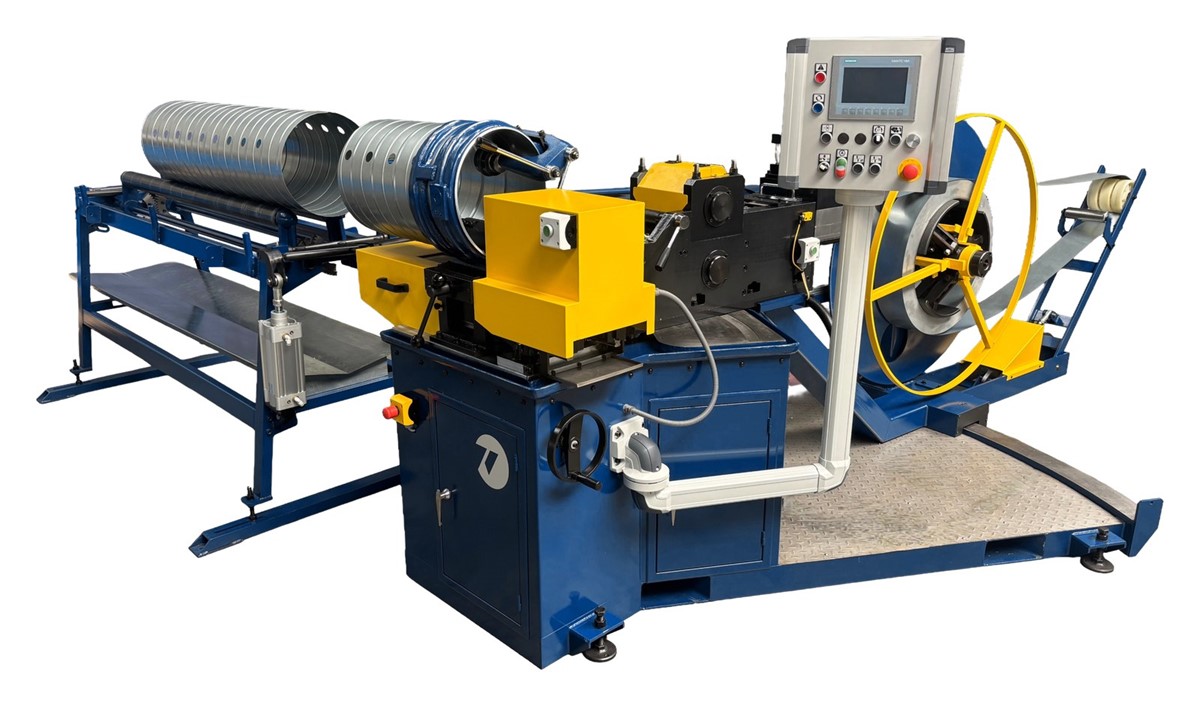
WAMMES Tubeformer TF 1401 Ultra, shown with a perforated duct. Perforating is an option; as standard the machine produces plain ducts.
WAMMES Tubeformer TF 1401 Ultra – spiral duct machine that produces round ducts from Ø 80 to 1,400 mm at up to 60 m/min, sheet thickness up to 1.0 mm. The 1 t decoiler and Siemens control are integrated, service comes from Wiebelsheim, Germany.
- 80 – 1,400 mmDuct diameter
- up to 60 m/minSpeed
- 0.4 – 1.0 mmSheet thickness (steel, alu)
- 1,000 kgCoil, decoiler integrated
Your advantages
- Up to 60 m/minRound ducts from Ø 80 to 1,400 mm, sheet 0.4 to 1.0 mm.
- Decoiler built inThe 1 t decoiler is built in, no separate decoiler next to the machine.
- Service from WiebelsheimAdvice, spare parts and service from one source.
Duct production
Sheet thickness (mm)
Coil
Connection and dimensions
Subject to technical changes. The details in the quotation are binding.
More advantages
- Quick changeover Quick-clamping system and forming cassettes, 2 sets included.
- Data via network Production data transfer via network, ready for Industry 4.0.
- Calculate costs first Duct, consumption and ROI calculators right on this page.
Ducts per hour by diameter Ducts 3 m long, calculated guide values for continuous operation
TF 1401 Ultra, 60 m/min TF 1600 Ultra, 80 m/min
Pieces per hour
All 31 standard diameters as a table
| Ø mm | TF 1401 ducts/h | TF 1401 m/h | TF 1600 ducts/h | TF 1600 m/h |
|---|---|---|---|---|
| 80 | 266 | 798 | 312 | 936 |
| 90 | 250 | 750 | 296 | 888 |
| 100 | 236 | 708 | 281 | 843 |
| 112 | 221 | 663 | 264 | 792 |
| 125 | 206 | 618 | 249 | 747 |
| 140 | 191 | 573 | 233 | 699 |
| 150 | 183 | 549 | 223 | 669 |
| 160 | 175 | 525 | 214 | 642 |
| 180 | 161 | 483 | 198 | 594 |
| 200 | 149 | 447 | 184 | 552 |
| 224 | 136 | 408 | 170 | 510 |
| 250 | 125 | 375 | 157 | 471 |
| 280 | 114 | 342 | 144 | 432 |
| 300 | 108 | 324 | 136 | 408 |
| 315 | 104 | 312 | 131 | 393 |
| 355 | 94 | 282 | 119 | 357 |
| 400 | 85 | 255 | 108 | 324 |
| 450 | 76 | 228 | 98 | 294 |
| 500 | 70 | 210 | 90 | 270 |
| 560 | 63 | 189 | 81 | 243 |
| 600 | 59 | 177 | 76 | 228 |
| 630 | 57 | 171 | 73 | 219 |
| 710 | 51 | 153 | 66 | 198 |
| 800 | 45 | 135 | 59 | 177 |
| 900 * | 41 | 123 | 53 | 159 |
| 1,000 * | 37 | 111 | 48 | 144 |
| 1,120 * | 33 | 99 | 43 | 129 |
| 1,250 * | 30 | 90 | 39 | 117 |
| 1,400 * | 27 | 81 | 35 | 105 |
| 1,500 * | – | – | 33 | 99 |
| 1,600 * | – | – | 31 | 93 |
Up to Ø 800 mm, the machine automatically ejects the ducts onto the receiving table. Larger ducts are too heavy for this and are removed by crane or forklift. For these diameters (shown lighter, * in the table) the output applies without removal; the actual number of pieces depends on removal.
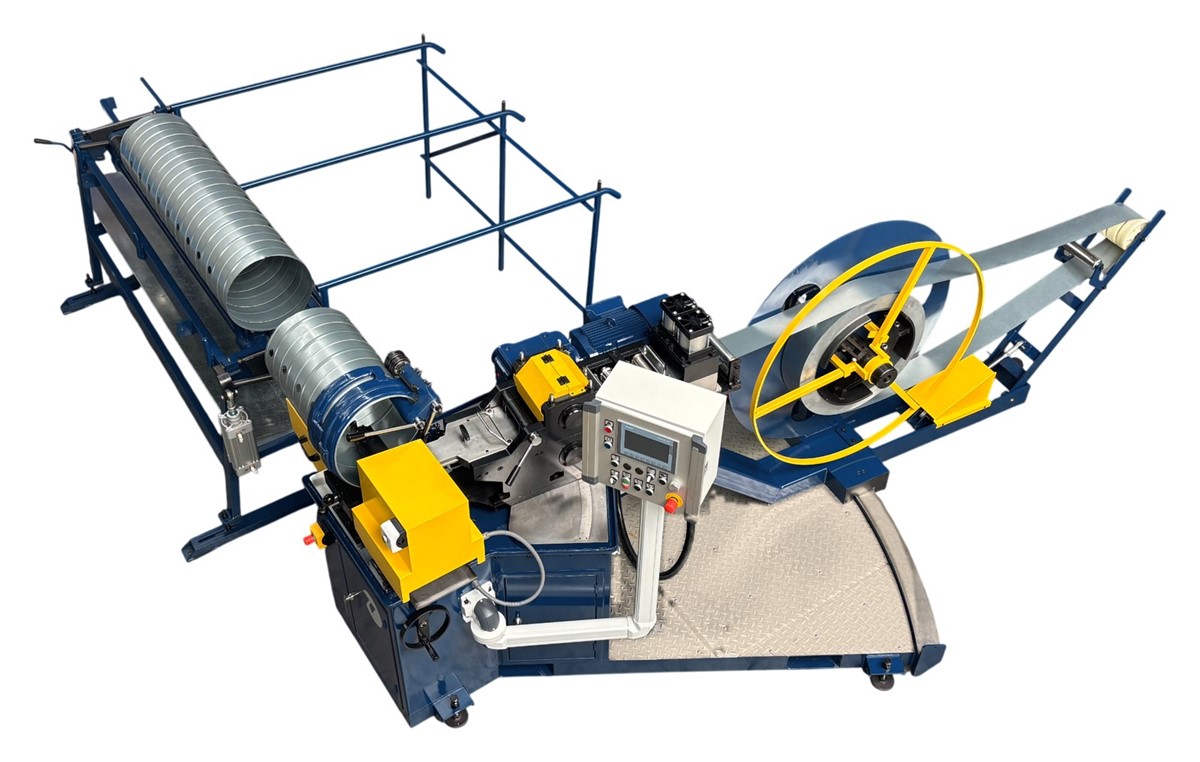
From coil to finished duct in five steps
 1
2
3
4
5
- Decoiling The coil (up to 1,000 kg) sits on the integrated decoiler.
- Edge forming Strip guide and roll former profile both strip edges.
- Winding The forming head winds the strip helically into a duct.
- Seaming The pair of closing rollers presses the edges into a lock seam.
- Cutting and unloading The flying rotary cutter cuts the duct, the unloading device removes it.
Spiral duct is the standard solution for circular air ducts in ventilation and air-conditioning systems. It is made from a sheet metal strip that is wound helically and seamed continuously.
- Rigid: The continuous spiral seam stiffens the duct. It is more rigid than a longitudinally seamed duct of the same sheet thickness. Larger diameters also receive a stiffening bead; the TF 1401 Ultra forms single or double beads.
- Standardised: EN 1506 defines the dimensions of circular air ducts, EN 12237 their strength and leakage. With lip-seal fittings, spiral duct systems can reach air tightness class D, the tightest class of the standard.
- Economical: For the same cross-section, a circular duct needs less material than a rectangular duct. Connections are usually made with push-fit connectors and rubber seals, without sealant.
- Flexible: Ducts are usually 3 m long. Duct length is theoretically unlimited: one run-out table covers up to 4 m; for longer ducts, further tables are added in line.
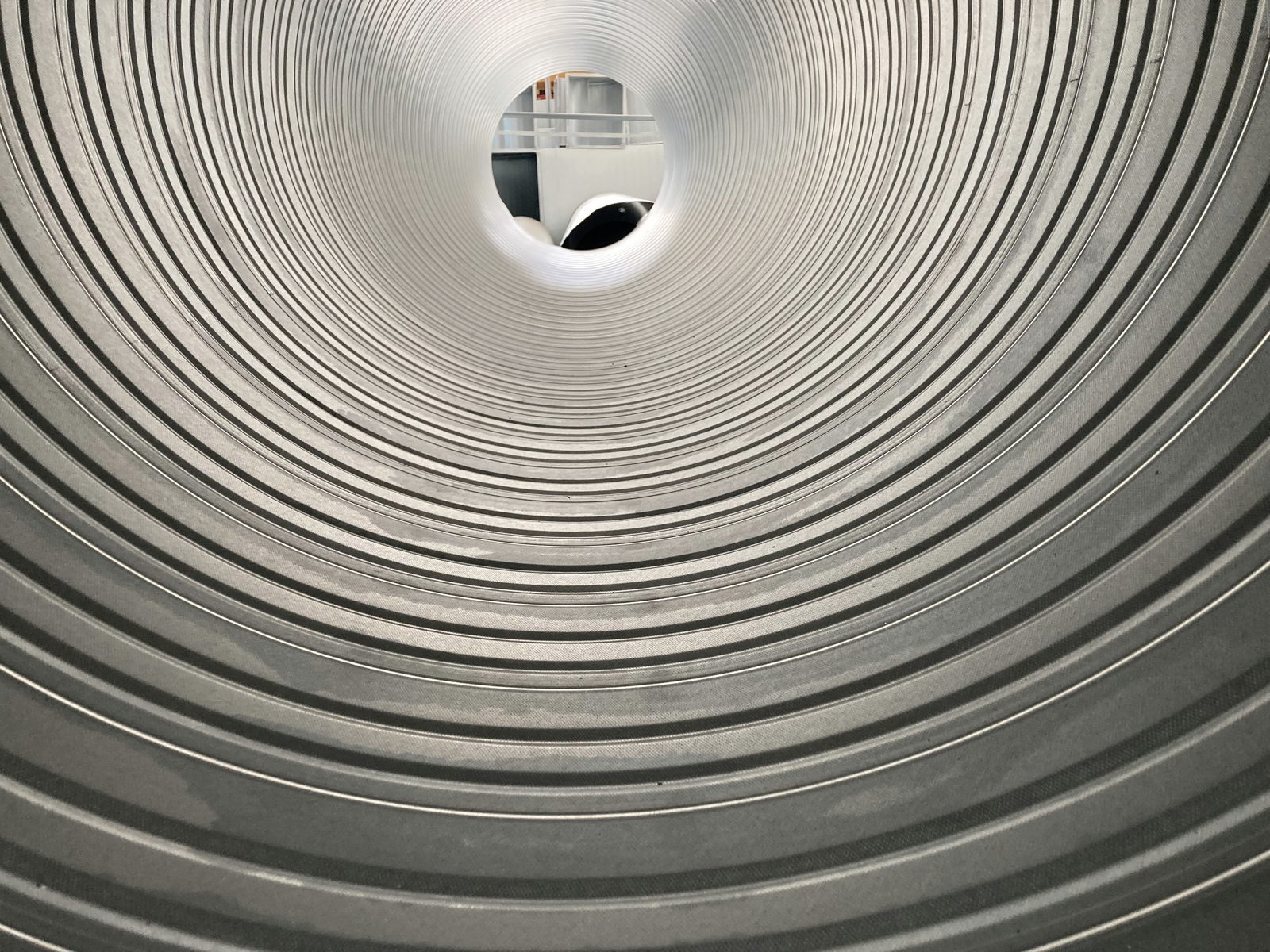
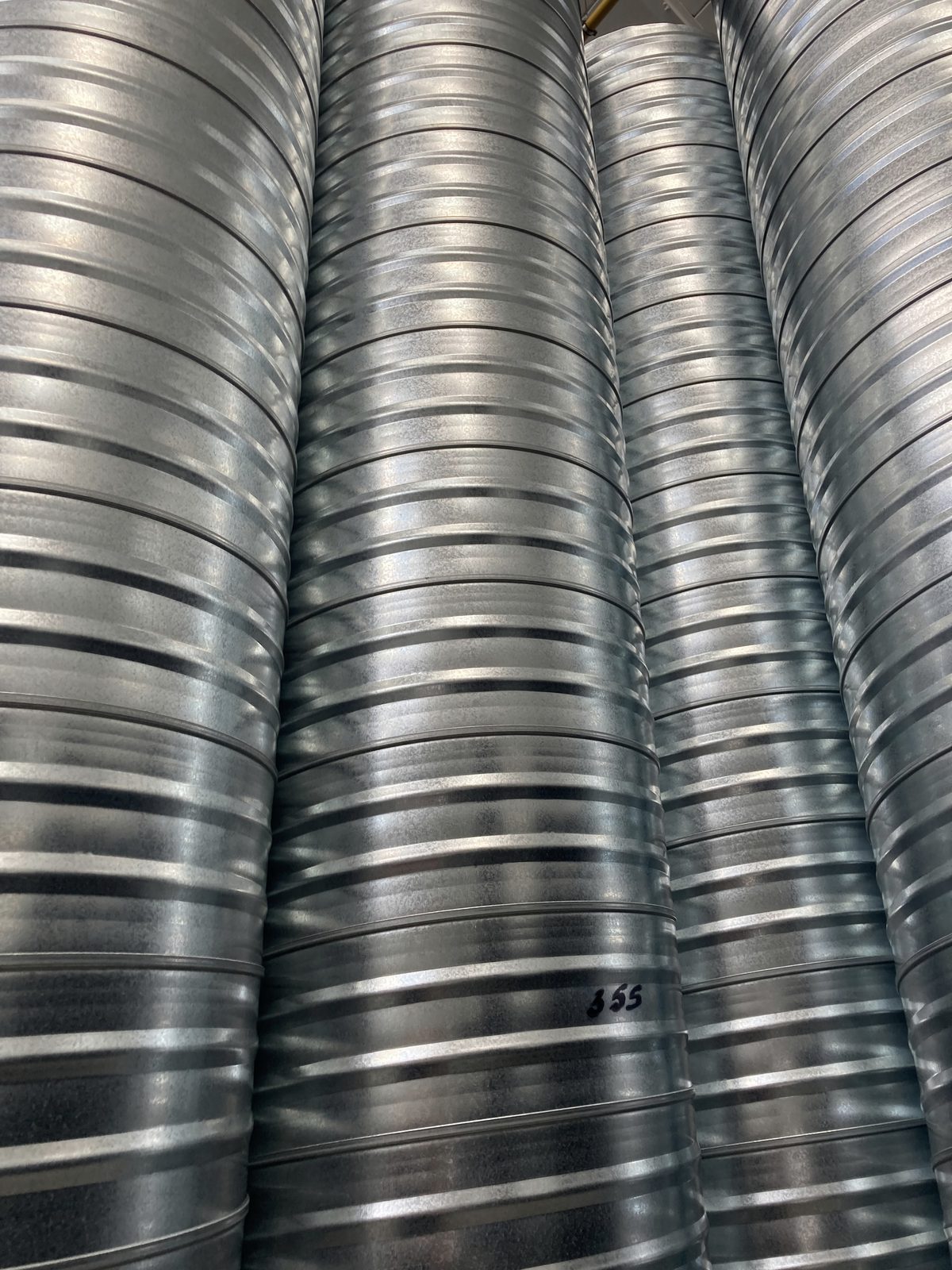
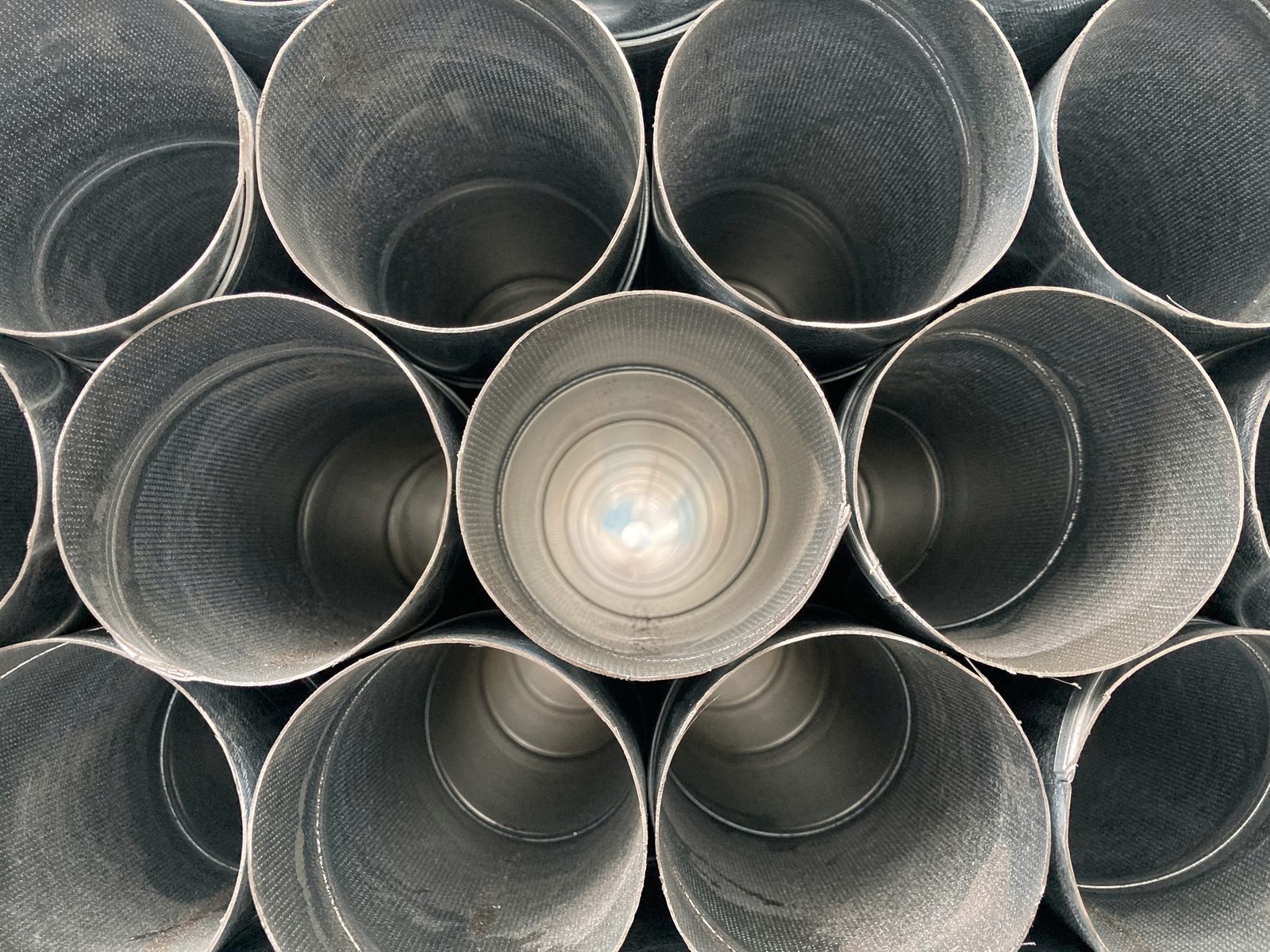
All ducts produced on a WAMMES Tubeformer. Tap an image to enlarge.
Tap an image to enlarge. Tap again or × to close it.
Option Minimum-quantity lubrication WAMMES GLL ≥ 90 % biodegradable (OECD 301B) Plant-based renewable raw materials Not hazardous not classified under the CLP Regulation
More about WAMMES GLL
Nozzles spray finely dosed oil exactly where the strip needs it. Instead of emulsion, a biodegradable, plant-based lubricating oil.
- Not a hazardous substance, no labelling, REACH-compliant
- Not classified as skin or eye irritant
- No emulsion to prepare, maintain and dispose of
- No hazardous waste, no dangerous goods
- Clean machine, less cleaning
- Economical: only as much oil as needed
Standard: emulsion lubrication. Oil data according to the manufacturer's safety data sheet (06/2026).
Scope of delivery
- Machine with seaming station, cutting unit and strip guide
- Roll former with 2 sets of forming cassettes
- Drive (motor, gearbox), receiving table with unloading device, lubrication system
- Forming tool and accessories (rotary cutters, closing rollers, beading rollers)
- Motorised angle adjustment
- Production data transfer via network (Industry 4.0 ready)
The scope of delivery may vary depending on the order.
Spiral ducts with dimensions to EN 1506 and strength and leakage to EN 12237. Also designed for SMACNA, AFNOR, BS EN and Eurovent.
What applies
- EN 1506:2007 – dimensions of circular sheet metal air ducts and fittings: nominal diameters and tolerances. The standard does not specify a sheet thickness.
- EN 12237:2003 – requirements and test methods for strength and air leakage of circular sheet metal ducts, with air tightness classes A to D (D is the tightest).
- EN 16798-3:2025 – defines air tightness classes for ductwork systems with new names (ATC 7 to ATC 1). Future editions of EN 12237 are to adopt these names.
- Further codes for which the machine is designed: SMACNA HVAC Duct Construction Standards (USA, sheet thicknesses by pressure class), AFNOR FD E51-620 (France, sheet thicknesses of seamed circular ducts), BS EN 1506 and 12237 (United Kingdom) and the recommendations Eurovent 2/2 (air leakage) and 2/3 (dimensions).
What matters in a duct
- Accurate diameter. Only then do couplings, nipples and fittings seal properly, including those from other manufacturers.
- Closed, even seam. It determines the rigidity and tightness of the duct.
- Sheet thickness matched to the diameter. Larger ducts are usually made from thicker sheet and with stiffening beads.
- Testable tightness. EN 12237 defines requirements and test methods for strength and air leakage.
EN 1506 and EN 12237 do not specify a sheet thickness per nominal diameter. The manufacturer chooses it so that the duct meets the requirements for strength and tightness. Manufacturers' catalogues usually list 0.5 mm for small and 0.8 to 1.0 mm for large diameters. The TF 1401 Ultra processes galvanised steel from 0.4 to 1.0 mm.
In use
Tap a field for the explanation.
Ventilation ducts and circular air ducts Ventilation and air-conditioning, supply and exhaust air
Classic application: circular air ducts and fittings for ventilation and air-conditioning systems in offices, halls, residential buildings and industry. The continuous seam makes the duct rigid; with lip-seal fittings, duct systems can reach air tightness class D to EN 12237. The TF 1401 Ultra produces Ø 80 to 1,400 mm.
Extraction ducts Extraction and dust collection systems: chips, dust, fumes
Extraction and dust collection systems carry chips, dust or fumes to the filter unit, for example in wood and metal working. Main line and branches are made of spiral duct, in galvanised steel or stainless steel depending on the medium.
Filter tubes and support cores Perforated tubes from pre-perforated strip for filter elements
Filter manufacturers wind perforated tubes from strip that is bought in already perforated, for example with round or square holes. In filter cartridges and coalescers, these tubes serve as support cores for the filter medium, for example in gas filtration. For perforating the strip in a separate operation, we offer separate systems.
Circular silencers Outer casing and perforated inner tube made of spiral duct
Circular duct silencers for ventilation systems consist of a spiral duct as outer casing and a perforated inner tube with mineral wool in between. Both tubes can be wound on the TF 1401 Ultra, the inner tube from pre-perforated strip.
Perforated air distribution ducts Distribute supply air evenly, perforation as an option in the machine
Perforated spiral ducts release supply air along their entire length and distribute it evenly in the room, for example in halls. As an option, we integrate an automated perforating unit into the TF 1401 Ultra. Alternatively, the machine processes pre-perforated strip.
Ducts with internal seam Smooth-walled jacket pipes for pre-insulated piping (option)
With an internal seam, the seam is on the inside and the outside stays smooth. Such ducts are used as jacket pipes for pre-insulated piping in the chemical, petrochemical, food and refrigeration industries, for example in aluminium or stainless steel. The internal seam is an option of the TF 1401 Ultra.
Formwork tubes for concrete Formwork for round columns and pillars, recesses and sleeves
Spiral ducts serve as formwork for round concrete columns and pillars, as recesses and sleeves in walls and ceilings, or as pile sleeves. The continuous seam stiffens the tube against the pressure of the fresh concrete. Depending on the construction method, the tube remains as lost formwork or is removed after curing.
Stainless steel and aluminium ducts Galvanised steel, stainless steel or aluminium
The TF 1401 Ultra processes galvanised steel and aluminium from 0.4 to 1.0 mm and stainless steel from 0.4 to 0.6 mm. This produces ducts for standard ventilation as well as for humid or aggressive environments.
Is the TF 1401 Ultra right for your duct production? We advise you on diameter, material, decoiler and installation.
Request a quoteDemo machine TF 1401 Ultra, as new: Details in the marketplace, price on request.
View demo machineVideo
Play video
One click starts the video here on the page. Only then is a connection to YouTube established; YouTube's privacy policy applies.
Trial winding in Wiebelsheim
See the TF 1401 Ultra in operation before you decide. At our plant in Wiebelsheim we wind trial ducts – with your own material or with ours.
- free of charge and without obligation
- with your coil or our material
- sample ducts to take with you
Frequently asked questions
Click a question to see the answer. Click again to close it.
What is a spiral duct?
A circular air duct made from a sheet metal strip that is wound helically and seamed continuously. The spiral seam makes the duct rigid. Dimensions to EN 1506, strength and leakage to EN 12237.
Which duct diameters does the TF 1401 Ultra produce?
Duct diameters from 80 to 1,400 mm. Duct length starts at 300 mm and is theoretically unlimited. One run-out table covers ducts up to 4 m; for longer ducts, further tables are placed in line (3 m per table).
Which materials and sheet thicknesses are possible?
Galvanised steel 0.4 – 1.0 mm, stainless steel 0.4 – 0.6 mm and aluminium 0.4 – 1.0 mm.
To which standards are the ducts produced?
Dimensions to EN 1506, strength and leakage to EN 12237. The machine is also designed for ducts to SMACNA (USA), AFNOR FD E51-620 (France), BS EN (United Kingdom) and the Eurovent recommendations.
What is the WAMMES GLL minimum-quantity lubrication?
An option instead of the standard emulsion: nozzles spray finely dosed oil onto the strip. WAMMES GLL is at least 90 % biodegradable (OECD 301B) and not a hazardous substance.
Can the TF 1401 Ultra produce spiral ducts with an internal seam?
Yes, as an option. With an internal seam, the seam is on the inside and the outside of the duct stays smooth. Such ducts are used, for example, as jacket pipes for pre-insulated piping.
Can perforated tubes such as filter tubes be produced?
Yes. As an option, we integrate an automated perforating unit into the machine, for example for perforated air distribution ducts. The machine can also process pre-perforated strip, for example for support cores in filter elements or inner tubes of duct silencers. For perforating in a separate operation, we also offer separate systems.
What are spiral ducts used for apart from ventilation?
For example for extraction systems, as perforated support cores in filter elements and for duct silencers (both from pre-perforated strip), as jacket pipes with internal seam (option) for pre-insulated piping and as formwork tubes for round concrete columns.
How many ducts does the machine produce per hour?
For ducts 3 m long, approx. 266 pieces per hour at Ø 80 mm, 149 at Ø 200 mm, 70 at Ø 500 mm, 37 at Ø 1,000 mm and 27 at Ø 1,400 mm (calculated guide values; above Ø 800 mm without removal by crane or forklift). At 80 m/min, the TF 1600 Ultra produces approx. 312, 184, 90, 48 and, at Ø 1,600 mm, 31 pieces. All diameters are listed under “Output”.
Which coils can the machine process?
Coils up to 1,000 kg with an outer diameter of up to 1,200 mm. The clamping device takes inner diameters from 480 to 530 mm; common 508 mm coils fit. Strip width 137 mm.
How is the machine operated?
Winding and unloading of the ducts are done at the push of a button. Quantity and lengths are entered on the Siemens control.
How is the spiral seam formed?
The strip, profiled on both edges, is pressed into a forming tool and wound helically. The edges overlap and the pair of closing rollers presses them into a positive-locking, airtight seam. A pair of travelling rotary cutters cuts the duct to length. The standard unloading device removes the duct from the receiving table.
What connections and space does the machine need?
7.5 kW, 400 V, 50 Hz; compressed air 6.0 – 8.0 bar, approx. 100 l/min. Floor space 6,500 × 5,000 × 1,800 mm, weight 2,750 kg. Intended for dry rooms, 10 – 55 °C, 5 – 90 % humidity. 2 m clearance at the operating area, 4 m manoeuvring space for lifting equipment at the decoiler, at least 1 m service area around the machine.
How does the TF 1401 Ultra differ from the TF 1600 Ultra?
The TF 1600 Ultra produces diameters from 80 to 1,600 mm, steel and aluminium up to 1.25 mm (stainless steel up to 0.8 mm), at up to 80 m/min with 11 kW connected load.
Do you take my old machine in part exchange?
Yes, talk to us. We inspect your old machine and make you an offer.

Mathias Wammes
CEO & Sales

Dmitri Lang
CEO & Technical Support
